Tripartite Cooperation Framework Agreement for the World’s First Pilot Project of Solvent‑Based Recycling of Waste HDPE Officially Signed in Shanghai
Shanghai, April 19, 2026 —
During the 38th China International Exhibition on Plastics and Rubber Industries (Chinaplas 2026), Henan Pingyuan New Material Technology Co., Ltd., Cevia Renewable Resources Technology (Henan) Co., Ltd. , and Sulzer Ltd., officially signed a Tripartite Cooperation Framework Agreement, paving the way to the world’s first kiloton-scale pilot project for solventbased recycling of waste HDPE.
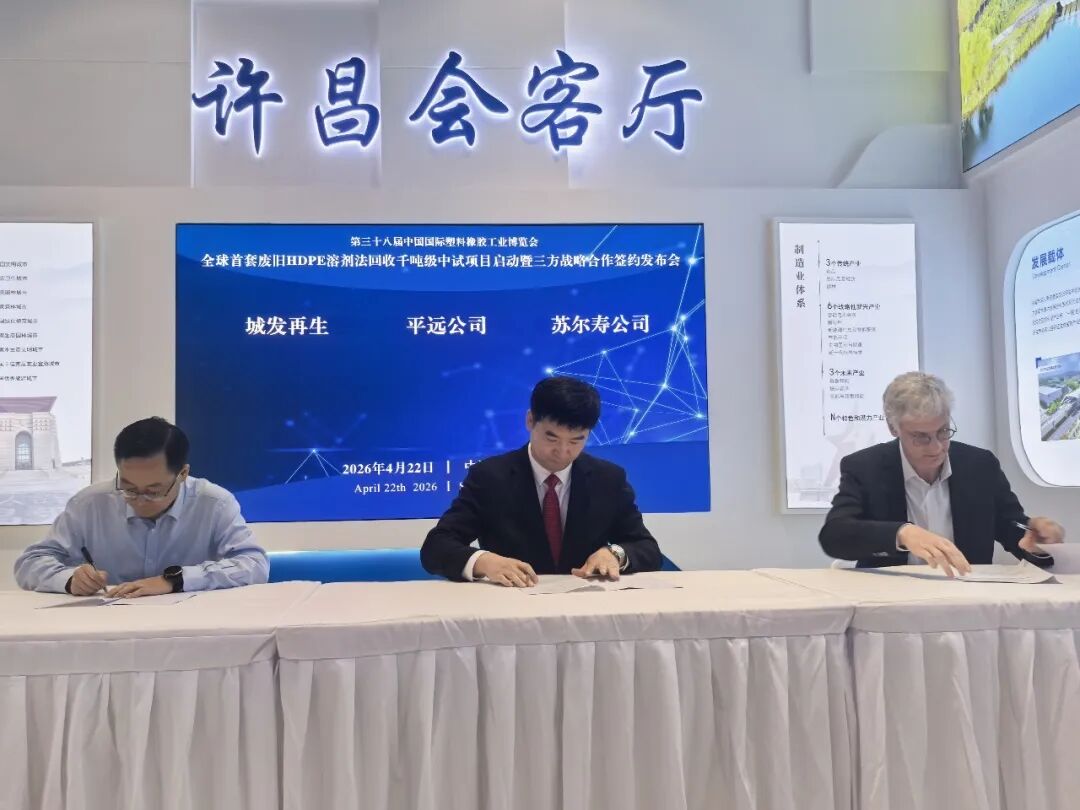
At the signing ceremony and press conference, representatives from Xuchang City and Yanling government authorities, Henan Pingyuan New Material Technology Co., Ltd., Cevia Renewable Resources Technology (Henan) Co., Ltd. , Sulzer Ltd., Chinese Academy of Sciences, China University of Petroleum, China Kunlun Contracting and Engineering Corporation, The Plastic Recycling Branch of the China Synthetic Resin Association, TÜV Rheinland AG ,and BRICS Institute India attended and delivered statements.
Their presence demonstrated strong and broad-based support from local governments, industry, research institutions, trade associations, third-party certification bodies, and international organizations.
The project aligns with the Paris Agreement (UNFCCC) and China’s “Dual Carbon” (carbon peaking and carbon neutrality) strategy, representing a high-level international collaboration in the field of plastic circular economy.
By leveraging their respective technical expertise and resource strengths, the three parties aim to accelerate the transition of solvent based recycling technology for waste HDPE from laboratory research to kiloton-scale industrial pilot operation, addressing a critical gap in the global industry..
Driven by increasingly stringent global regulations, demand for high‑quality recycled HDPE in the premium circular plastics market is growing rapidly. However, existing production technologies face significant uncertainty in consistently meeting the required quality standards.
This innovative project addresses the inherent limitations of traditional mechanical recycling—characterized by low value and downcycling—as well as the high cost challenges of chemical recycling. It aims to evaluate the feasibility of a new technological and commercial pathway based on “solvent based technology + high value recycling.”
The project s explores the potential transformation from “waste treatment” to “high value resource regeneration,” effectively addressing bottlenecks in the supply of premium recycled materials.
The pilot project aims to provide stable, high-quality raw materials for downstream high-end applications such as food packaging, automotive, and electronics, supporting the development of China’s domestic and international dual circulation economic model.
It will also offering a scalable solution from China to the achievement of national “dual carbon” targets and global plastic pollution mitigation.
All parties agreed that the project has broad prospects and far-reaching significance, and is expected to become a landmark demonstration project and a global benchmark in the circular plastics economy.